The Andean Geothermal Center of Excellence (CEGA) at the University of Chile had a prominent presence at the 2026 World Geothermal Congress (WGC), held from June 8 to 11 in Calgary, Canada.
The event, organized by the International Geothermal Association (IGA) and Geothermal Canada, brought together researchers, industry representatives, public agencies, and decision-makers from around the world to address the challenges and opportunities of geothermal energy in the context of the global energy transition.
At this year’s congress, the CEGA team presented scientific findings related to geothermal exploration, the characterization of hydrothermal systems, and the study of minerals associated with geothermal activity in Chile and the Andean region.
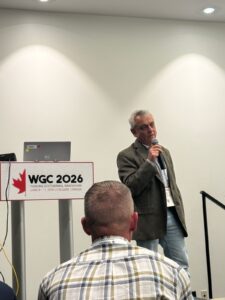
One of the highlights of Chile’s participation was a presentation by CEGA Director and Full Professor at the University of Chile, Dr. Diego Morata, during the “Country Update” session, which focused on the current state of geothermal development in different countries. In his presentation, he discussed the progress, challenges, and opportunities Chile faces in geothermal exploration, research, and resource utilization.
In addition, the University of Chile researcher and faculty member presented the study “Li-rich clays in Andean systems: the influence of geothermal activity in their genesis,” which examines the role of geothermal activity in the formation of lithium-rich clays in Andean systems.
 sistemas andinos.
“El Congreso Mundial de Geotermia es el principal espacio de encuentro para la comunidad geotérmica internacional. Participar en esta instancia nos permite mostrar los avances que se están desarrollando en Chile, compartir conocimiento con investigadores de todo el mundo y fortalecer redes de colaboración que son fundamentales para seguir impulsando el desarrollo de la geotermia en nuestro país y la región. Esta instancia también nos permite ver el avance (lento) en I+D+i de la geotermia en Latinoamérica así como constatar que la ciencia que hacemos en Chile (y, en particular en el CEGA) es de muy alto nivel y con resultados totalmente comparables a los mostrados por investigadores de países más desarrollados”, señaló Diego Morata.
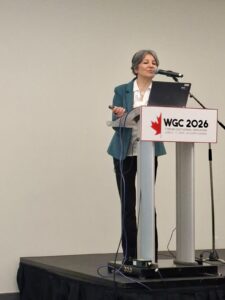
For her part, Gloria Arancibia, CEGA researcher and Full Professor at the Pontifical Catholic University of Chile (PUC), presented the study “The Nevados de Chillán as a Fault-Controlled Geothermal System in Southern Chile: A Review of the Latest Advances Toward a New Conceptual Model,” which addressed recent progress in understanding the Nevados de Chillán geothermal system and the development of a new conceptual model for this important geothermal field in southern Chile.
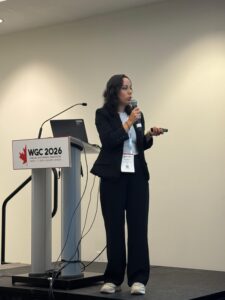
““Presenting the advances achieved at Nevados de Chillán was an opportunity to share results that improve our understanding of one of Chile’s most significant geothermal systems. These studies help reduce uncertainties in geothermal exploration and contribute to the development of increasingly robust conceptual models for this type of resource,” the researcher explained Micaela Villarroel, a PhD student at CEGA, presented the study “Calabozos Hydrothermal System: An Approach from Petrology and Geochemistry of Hydrothermal Alteration,” focused on characterizing the Calabozos hydrothermal system using petrological and hydrothermal alteration geochemistry tools, providing new insights for geothermal resource exploration. nuestra comprensión de uno de los sistemas geotérmicos más relevantes de Chile. Estos estudios contribuyen a reducir incertidumbres en la exploración y permiten avanzar hacia modelos conceptuales cada vez más robustos para el desarrollo de este tipo de recursos”, explicó la investigadora.Micaela Villarroel, estudiante PhD del CEGA, en tanto, presentó el estudio “Calabozos Hydrothermal System: An Approach from Petrology and Geochemistry of Hydrothermal Alteration”, enfocado en la caracterización del sistema hidrotermal Calabozos mediante herramientas de petrología y geoquímica de alteración hidrotermal, aportando nuevos antecedentes para la exploración de recursos geotérmicos.
““Participating in WGC 2026 gave us the opportunity to showcase research that combines geology, petrology, and geochemistry to better understand how hydrothermal systems operate. It was also a highly valuable opportunity to learn from international experiences and discuss new methodologies applied to geothermal exploration,” Micaela highlighted. combinan geología, petrología y geoquímica para comprender mejor el funcionamiento de los sistemas hidrotermales. Además, fue una instancia muy enriquecedora para conocer experiencias internacionales y discutir nuevas metodologías aplicadas a la exploración geotérmica”, destacó Micaela.
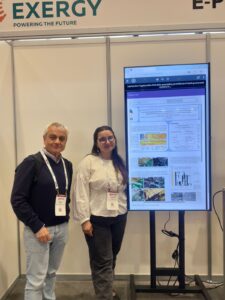
CEGA’s participation also included a scientific poster presented by Catalina Cerna, an MSc student at CEGA, titled “Laumontite-Yugawaralite-Wairakite Association as Evidence of Fossil Geothermal Systems in Cenozoic Formations from the Central Chilean Andes.” The study analyzes mineral assemblages that provide evidence of ancient geothermal systems in the central Chilean Andes, contributing to a better understanding of hydrothermal evolution in volcanic environments.
CEGA’s presence at WGC 2026 provided an opportunity to showcase research conducted in Chile, strengthen ties with the international scientific community, and contribute to the global discussion on the role of geothermal energy in the energy transition and sustainable development.
The World Geothermal Congress is the leading international event for the geothermal sector and is held every three years, bringing together researchers, companies, public agencies, and geothermal industry leaders from around the world. The next congress will be held in Kenya in 2029.